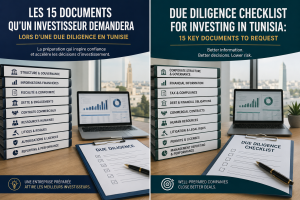
Due Diligence Checklist for Investing in Tunisia: 15 Key Documents to Request
Why Documentation Matters
When evaluating an investment opportunity in Tunisia, investors need more than financial statements.
A well-structured Due Diligence process helps validate assumptions, identify risks and assess the company’s ability to generate future value.
The quality and availability of documentation often provide the first indication of a company’s level of investment readiness.
Below are 15 key documents investors should request during a Due Diligence process.
1. Articles of Association
To understand the company’s legal structure and governance framework.
2. Shareholder Register
To verify ownership structure and equity distribution.
3. Financial Statements for the Last Three Years
To assess historical performance, profitability and financial stability.
4. Detailed Trial Balance
To perform a deeper review of accounting records.
5. Tax Filings and Tax Compliance Documentation
To identify potential tax exposures and compliance risks.
6. Debt Schedule and Banking Facilities
To understand existing financial obligations.
7. Fixed Asset Register
To verify ownership and condition of key assets.
8. Major Customer Contracts
To assess revenue stability and customer concentration risk.
9. Strategic Supplier Agreements
To evaluate operational and supply chain risks.
10. Organizational Chart
To understand management structure and key responsibilities.
11. Employment Agreements for Key Executives
To assess key-person dependency risks.
12. Business Plan and Financial Forecasts
To evaluate growth assumptions and investment potential.
13. Litigation and Legal Disputes Summary
To identify potential liabilities.
14. Licenses, Permits and Regulatory Approvals
Particularly important in regulated industries.
15. Management Reporting and KPI Dashboards
To assess management quality and decision-making processes.
Conclusion
A company’s ability to provide these documents quickly and accurately is often a strong indicator of investment readiness.
For investors, requesting these documents early helps identify risks, accelerate decision-making and improve transaction efficiency.
For business owners, maintaining a structured Data Room significantly enhances credibility and attractiveness during fundraising or acquisition discussions.
A successful transaction often starts with proper preparation.